
Performer's note: Sonata for Cello and Piano in D minor, L. 135 (1915) by Claude Debussy (1862-1918)

Updated: Jun 18, 2025
Composed in the tumultuous year of 1915 amidst the ravages of World War I and Debussy's own declining health, the Sonata for Cello and Piano is a poignant and deeply personal work. It was intended as the first in a planned series of six sonatas for various instruments, though only three were completed.
About the Debussy Cello Sonata
Debussy eschewed the grand Romantic gestures of previous eras, opting instead for a concise, almost aphoristic style that distills emotion and character into concentrated forms. While highly original, the sonata subtly harks back to earlier French traditions, evoking the spirit of the commedia dell'arte and the elegance of Couperin and Rameau.
The sonata unfolds in three interconnected movements:
Prologue: Opens with a searching, improvisatory cello line against shimmering piano textures. It's a movement of shifting moods, at once delicate, introspective, and full of restless energy.
Sérénade (Modérément animé): A whimsical and often sarcastic "serenade" that juxtaposes pizzicato lightness with fleeting moments of tender lyricism. Its character is reminiscent of a mischievous character from a theatrical troupe.
Finale (Animé, léger et nerveux): A virtuosic and energetic conclusion, marked by rapid passages and sudden dynamic contrasts. It brings the sonata to a vibrant, if somewhat bittersweet, close, often interpreted as a defiant burst of freedom or even a sense of playful abandon amidst underlying tension.
Though Debussy himself discouraged overly literal programmatic interpretations, the sonata's dramatic shifts, lyrical beauty, and evocative colors have led many to associate it with the melancholic yet capricious figure of Pierrot. Regardless of any specific narrative, the Cello Sonata remains a masterwork, showcasing Debussy's late style – a testament to his profound artistry even in the face of adversity.
The "Pierrot" Connection and the Narrative:
Initial Conception: Debussy composed his Cello Sonata in 1915, as the first of a planned "Six Sonatas for various instruments." During this period, he was suffering from cancer and World War I was raging, leading to a more concise and often melancholic style in his music.
The Cellist's Claim: The connection to the commedia dell'arte character Pierrot (the sad clown) largely originates from a cellist named Louis Rosoor. After performing the sonata, Rosoor claimed in his program notes that Debussy had related the music to Pierrot and had even considered naming it "Pierrot angry at the moon" (Pierrot fâché avec la lune).
Rosoor's Narrative: Rosoor went on to publish a short descriptive narrative in his program notes, interpreting each movement:
Prologue: "Pierrot wakes up with a start and shakes off his stupor. He rushes off to sing a serenade to his beloved [the moon] who, despite his supplications, remains unmoved."
Sérénade: (Continues the serenade, highlighting the moon's unresponsiveness).
Finale: "To comfort himself in his failure he sings a song of liberty."
Debussy's Response: Importantly, Debussy himself denied this specific programmatic interpretation. He wrote a letter to his publisher, Durand, on October 16, 1916, stating that Rosoor had visited him the previous night and seemed to have misunderstood him and the music. While Debussy was certainly influenced by the commedia dell'arte characters and a sense of French classicism (especially Rameau and Couperin), he preferred the music to speak for itself rather than adhere to a rigid program.
Performer's / Practice note by Dominic Na
I put the handwritten notes in the images below.
The video demonstration is for understanding the intentions of my interpretation and musical nuances. I don't recommend practicing while playing this video.
I created content whenever I had some time. I hope you understand my casual appearance and the quality of the recordings I took with my mobile device.
Click the arrow on the left to view the contents.
I. Prologue - Lent mm.1 - 15


I. Prologue - Lent mm.16-28


I. Prologue - Lent mm. 29-38
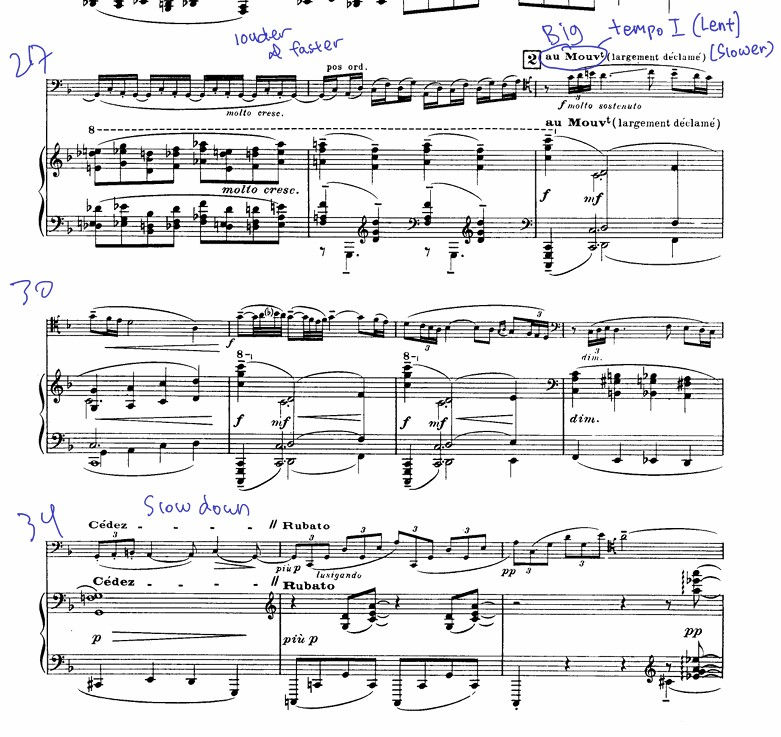

I. Prologue - Lent mm. 39-51

II. Serenade et Finale - Moderement anime mm. 1-11

II. Serenade et Finale - Moderement anime mm. 12-18

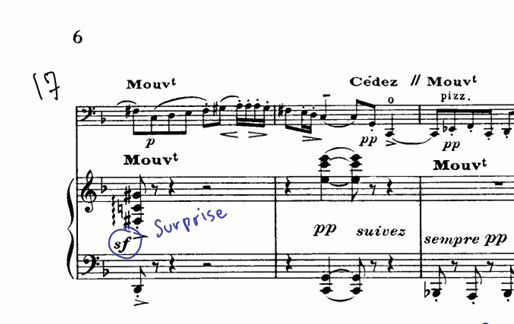
II. Serenade et Finale - Moderement anime mm. 19-25

II. Serenade et Finale - Moderement anime mm. 26-30

II. Serenade et Finale - Moderement anime mm. 31-53


II. Serenade et Finale - Moderement anime mm. 54-64

III. Finale - Anime mm. 1-38


III. Finale - Anime mm. 39-68


III. Finale - Anime mm. 69-86


III. Finale - Anime mm. 87-123


Want to discover more strategies for learning or performing?
Sign up for lessons at THE CELLO STUDIO! I'd be happy to help you.


Comments